POSTED ON 20 JUL 2026
READING TIME: 5 MINUTES
Seven QA Engineers Walk into Madrid: Our expoQA 2026 Report
Every year, we face a choice about how to spend our learning budgets.
At Sonalake, each team member has a dedicated training allowance. Our QA team usually tries to pool theirs together for a shared conference experience. Not everyone always joins, and sometimes a highly specific online course or individual workshop makes more sense. But when the opportunity arises to travel as a group to a major industry event, the value usually goes far beyond the sessions themselves.
This year, seven of us (two manual QA engineers and five automation engineers) travelled to Madrid for expoQA 2026, held at the IFEMA convention centre.
We had not been to this particular conference before. It was partly a deliberate decision to try something new, and partly a matter of simple practicality: the budget aligned, and the schedule looked genuinely interesting.
What followed was two days of talks, four parallel tracks, a heatwave, and some excellent local food. But the most interesting part was what we noticed when we actually sat down in the halls.
Moving past the panic
If you attended any software testing events over the last two years, you will remember a distinct atmosphere of anxiety. The dominant question in every hallway and panel discussion was existential: will generative AI replace the testing team?
In Madrid, we noticed that the anxiety had largely disappeared.
It was a change that made the entire event feel different from the conferences of 2024 or 2025. That speculative tone got replaced by practical, sometimes messy, and highly honest accounts of teams using these tools in their daily workflows.
Rather than arguing about whether machines will take our jobs, engineers were sharing what happens when you actually try to embed these models into a pipeline, where they save time, and where they create more problems than they solve.
What we heard on the main stage
Keynotes at large events can occasionally feel too high-level to be useful, offering inspiration that tends to fade by lunchtime. In Madrid, however, the main sessions consistently connected back to the real challenges of building software.
Rob Sabourin opened the event by looking at how intelligent automation is changing testing leadership. His argument was that we need to separate testing fundamentals from specific, temporary tools. In a world where tooling changes by the month, the key is to build adaptive strategies rather than tool-dependent architectures.
Nicole van der Hoeven built on this idea by using Isaac Asimov's laws of robotics to talk about systems monitoring. Her point was simple yet profound: observability is the absolute prerequisite for any safety or ethical guarantees we want from modern software. If you cannot see what a system is doing, you cannot trust it.
On the second day, Pablo Garcia reminded the room of an old truth that is easily forgotten in the rush to adopt new technology: doing things right the first time remains the fastest and cheapest approach. The technical waste generated by teams trying to shortcut this understanding compounds long after a project is finished.
By the time Rhian Lewis closed the conference by using science fiction classics like The Matrix and Westworld to illustrate real-world testing blind spots, we all realised the same thing. The industry is moving past the initial shock of new technology and returning to classic engineering principles: design, observability, and discipline.
Our team's individual take
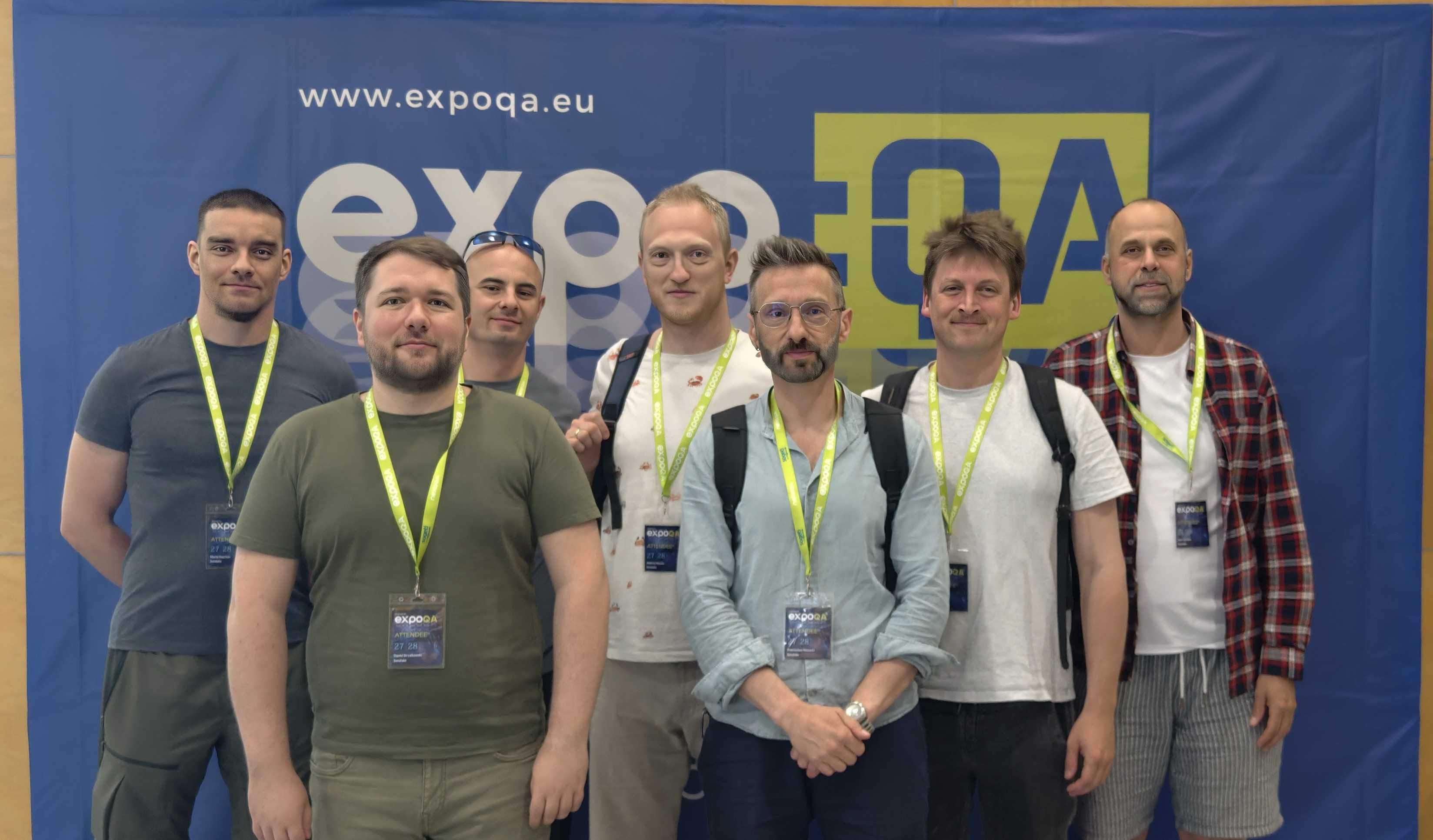
Because we attended as a diverse group of seven, we split up to cover as many of the parallel tracks as possible. When we compared notes afterward, we found we all focused on slightly different things depending on our daily roles.
Przemek's Take
"The session that stayed with me most was by Sharath Byregowda, detailing a two-year journey of continuous marginal gains. There were no overnight transformations or magic tools. Instead, it was about small, consistent steps: refining test architecture, deploying real-time dashboards, and slowly reducing flakiness to under one percent. In contrast, another talk promised a highly technical story about ethical API hacking, but delivered little more than an atmospheric narrative about signing contracts over dinner. The contrast was a great reminder that real progress in QA is usually steady, structured, and driven by data rather than storytelling."
Dawid's Take
"Three technical developments stood out as highly practical. First, the move toward automated API testing where tools generate tests directly from OpenAPI specifications, using delta detection to only update modified endpoints. Second, shifting left on accessibility by embedding automated audits directly into the build pipeline using Playwright and open-source libraries. Finally, the transition from traditional, flaky interface polling to real-time, bidirectional event listening. The takeaway for us is that automation must become more integrated and less reactive."
Kris & Maciek's Take
"Almost every session touched on intelligent automation in some way," Kris noted. "But the best ones were those that admitted what did not work. Dragan Spiridonov's presentation was excellent because it showed the inbetween mess: they achieved much faster test generation, but also encountered major issues when they let automated agents run without human guardrails."
Maciek agreed, adding: "The focus on collaboration between human testers and automated tools was a refreshing change from the usual alarmist predictions. It highlighted exactly where humans need to focus their creative energy and where machines can assist with scale."
The final verdict
Ultimately, we returned to our office in Poznań not with a desire for a sudden revolution, but with more confidence that steady, incremental improvement is the right approach.
The reinforced that quality engineering has moved beyond the initial hype around AI. The conversation has become much more practical, with the focus now on where these tools genuinely help and where they don't. Like most things in engineering, the biggest gains are likely to come from using them consistently and thoughtfully, rather than looking for a silver bullet.